Friday, October 16, 2026 / by Amy Masteller
Blog #7 Mortgage Rate Buydowns in Gillette, WY: A Simple Guide for Buyers and Sellers
Published by Amy Masteller
Amy Masteller, Licensed REALTOR® (Since 2024)
Brokerage: Signature Real Estate Group
1211 S Douglas Hwy Ste 90, Gillette, WY 82716
Last Updated: October 16, 2026
What is a mortgage rate buydown? A rate buydown is money paid upfront to lower your mortgage interest rate, which lowers your monthly payment. It can be temporary (the first year or two) or permanent (the life of the loan).
With rates climbing again, "buydown" is a word I'm hearing in just about every conversation with buyers and sellers here in Gillette, Wyoming. It sounds technical, but the idea is pretty simple once someone walks you through it.
So I sat down with a local lender, Laura Tetrault, Producing Branch Manager with Radiant Mortgage (NMLS #1048823), and asked her all my questions. We used a real Gillette number for every example: $363,905, the average sale price in Gillette according to our local MLS (as of early October 2026). Here's what I learned, in plain words.
Temporary vs. Permanent Buydowns
In Laura's words, a buydown is "paying some money upfront in exchange for a lower payment." There are two main kinds, and they work very differently.
Temporary buydown (like a 2-1)
A temporary buydown lowers your payment for the first few years only. The most popular is the 2-1 buydown:
- Year 1: your rate is 2% below the note rate
- Year 2: your rate is 1% below the note rate
- Year 3 and on: you pay the full note rate
So if your rate is 6.5%, year one is figured at 4.5%, year two at 5.5%, and then it settles at 6.5% for the rest of the loan.
Permanent buydown (discount points)
A permanent buydown lowers your actual interest rate for the life of the loan. You do this by paying discount points at closing. One point equals 1% of your loan amount.
Neither one is "better." As Laura put it, it really depends on your financial goals, how long you plan to keep the mortgage, and what you're trying to accomplish.
What a Buydown Looks Like on a $363,905 Gillette Home
Here's Laura's example using the average Gillette sale price, 5% down, a 30-year conventional loan, and an example rate of 6.5%. The loan amount is about $345,710.
2-1 temporary buydown
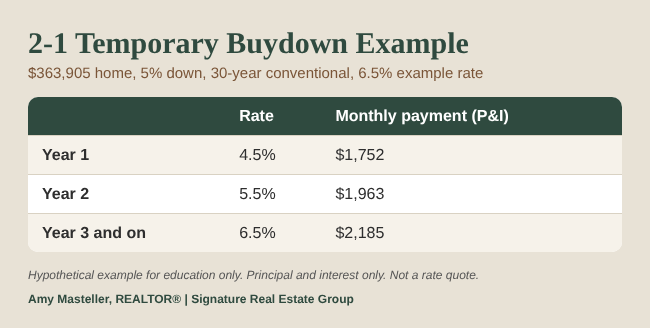
That's about $433 a month in savings the first year and $222 a month the second year. The cost of this 2-1 buydown: about $7,868.
Permanent buydown
If 1 discount point lowered the rate from 6.5% to 6.25%:
- New monthly payment: $2,129 (about $56 less per month, for the life of the loan)
- Upfront cost: about $3,457
This is a hypothetical example for education only. These numbers are principal and interest only. They don't include taxes, insurance, PMI, or other costs. The 6.5% rate and discount point pricing are examples to illustrate how buydowns work, not a current rate quote. Your actual numbers will depend on your loan, your credit, and the market on the day you lock.
What Laura loves about buydowns is that the same dollars can be used different ways. Maybe you want breathing room in your first couple of years, or maybe you want long-term savings.
How Long Do You Need to Stay for It to Be Worth It?
It depends on which kind of buydown you choose.
Permanent buydown: Laura always figures the break-even point, or how long it takes your monthly savings to pay back what you spent upfront. In our example, $3,457 divided by $56 a month is about 61 months, or just over five years. Stay longer, and you come out ahead.
Temporary buydown: The money is set aside upfront to cover part of your payment during the buydown years, so there isn't a traditional break-even to calculate.
Laura encourages buyers to look past today's rate and ask a few honest questions:
- How long do I realistically see myself keeping this mortgage?
- Am I hoping to refinance later?
- Is this my forever home, or more of a stepping stone?
What if rates drop and I refinance?
This is where the two types really differ.
- Permanent buydown: The discount points you paid are generally not refundable. Refinance six months later, and that money is gone.
- Temporary buydown: Any unused funds left in the buydown account are generally applied to lower your loan balance when you refinance, depending on the program's terms. If you refinance after year one of a 2-1, there could still be thousands of dollars left in that account.
That's why Laura likes to explore temporary buydowns when a buyer believes rates may improve. But as she reminded me, "we never want to build a mortgage strategy around a refinance that isn't guaranteed to happen."
Who Pays for a Buydown?
The buyer, the seller, and the builder can all contribute, depending on the loan program and the type of buydown.
- Buyers can pay discount points themselves for a permanent buydown.
- Temporary buydowns usually need to be funded by an eligible third party, like the seller, the builder, or the lender, depending on the program.
- Sellers can offer money toward a buyer's closing costs or a buydown instead of (or along with) a price reduction.
The key, Laura says, is structuring the incentive correctly so the buyer can actually use it. That's a conversation your agent and lender should have together before the offer is written.
Is there a limit on what a seller can pay?
Yes. Every loan program has its own rules. For conventional loans on a primary residence or second home, the limit depends on the down payment (based on Fannie Mae guidelines)
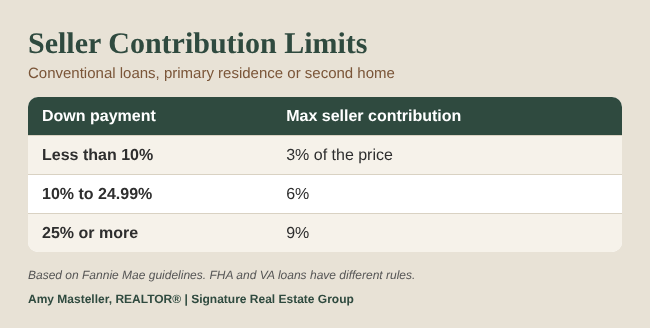
FHA loans generally allow up to 6%. VA loans have different rules, including a 4% limit on certain seller concessions (not every seller-paid cost counts toward that 4%).
One thing Laura always reminds Realtors: just because a seller can contribute a certain amount doesn't mean the buyer can use all of it. The actual closing costs, loan program, and buydown structure all matter.
Sellers: Is a Buydown Better Than a Price Drop?
Sometimes, yes. Here's the side-by-side Laura shared for a home listed at $363,905, with a buyer putting 5% down at 6.5%:
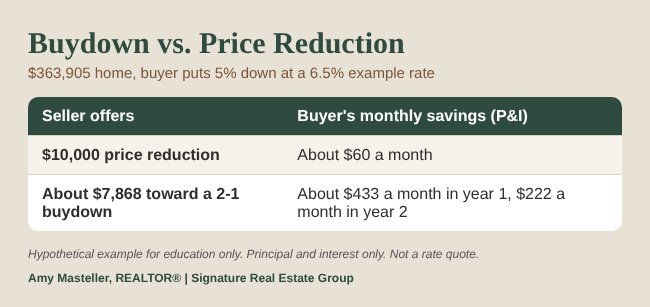
The seller spends less, and the buyer feels a much bigger difference in their monthly budget during those first two years.
Does that mean a buydown always wins? No. A lower price means borrowing less, possibly needing less cash for the down payment, and long-term savings for the buyer.
But if your home needs to stand out in Campbell County right now, it's worth asking your agent and a lender to run both options before you automatically drop the price. As Laura said, "Sometimes it's not about lowering the price. It's about making the payment more attractive."
When a Buydown Makes Sense (and When to Skip It)
It can be a great fit when:
- You'd like some breathing room in your first couple of years. Moving is expensive! Furniture, landscaping, and all the little things you didn't know you needed add up fast. A temporary buydown helps here.
- You plan to stay in the home a long time and want the stability of a lower rate for good. A permanent buydown fits this goal.
- You think rates may come down and you'd like flexibility, without counting on a refinance.
You might skip it when:
- You'd pay thousands for a permanent buydown but expect to sell or refinance within a year or so. The math probably won't work in your favor.
- A lower starting payment is tempting you to stretch your budget. You'll still need to qualify at the full note rate, and that full payment arrives in year three.
Laura's philosophy, and mine too: there's no one-size-fits-all mortgage. Two buyers can purchase the exact same house and have completely different goals. The right choice is the one that fits your situation.
Frequently Asked Questions
What is a 2-1 buydown?
A 2-1 buydown is a temporary buydown that lowers your rate by 2% in year one and 1% in year two. In year three, your payment returns to the full note rate for the rest of the loan.
Can a seller pay for my buydown in Gillette, WY?
Yes, in many cases. Sellers in Gillette and across Northeast Wyoming can often put money toward a buyer's buydown or closing costs, within the limits of the buyer's loan program.
Do I get my buydown money back if I refinance?
With a permanent buydown, generally no. With a temporary buydown, unused funds are generally applied to your loan balance when you refinance, depending on the program's terms.
Is a buydown better than a lower price?
It depends on your goals. A buydown often makes a bigger difference in your monthly payment early on, while a lower price means you borrow less over the life of the loan. A lender can run both for you.
Let's Find the Right Fit for You
Rates will keep moving. What matters most is finding a payment and a plan that feel right for your family. Whether you're buying your first home or getting ready to sell in Gillette or anywhere in Campbell County, I'd love to help you think through your options and connect you with a lender who can run your real numbers.
A big thank you to Laura for taking the time to share her knowledge with me and with you!
Laura Tetrault, Producing Branch Manager, Radiant Mortgage, NMLS #1048823
When you're ready to make a move, I'm ready to help.
Amy Masteller, REALTOR®
Signature Real Estate Group
307-680-4119 | amy@signaturegroupwy.com
Rooted in Relationships. Dedicated to Results.
This article is for general education only and is not a loan offer or commitment to lend. Rates, payments, and program guidelines change and vary by borrower. Talk with a licensed mortgage professional about your specific situation.